Blog · Websites & Lead Systems
Speed to Lead: Why the First Business to Reply Usually Wins the Job
WebScaling Team · October 06, 2026 · 11 min read
Quick answer: Speed to lead is the time between a customer reaching out (a call, form, chat or message) and your business replying. Research by Harvard Business Review found that firms trying to contact a lead within an hour were nearly seven times as likely to have a meaningful conversation as those who waited even an hour longer. Aim for an instant automatic reply and a real reply within minutes.
When someone needs a plumber, a dentist or a roof repair, they rarely contact just one business. They contact two or three, and the first one to get back with a clear answer often gets the job. This guide covers what the research actually says (and which popular stats you can't trust), and how a small team can reply faster without living on the phone.
What is speed to lead?
Speed to lead, also called lead response time, is how long it takes your business to respond after a potential customer gets in touch. The clock starts when they act: the moment a call goes unanswered, a form is submitted or a chat message is sent. It stops when they get a reply.
Example: Sarah fills in your quote form at 7:10pm. You call her back at 8:30am the next morning. Your speed to lead for that enquiry is 13 hours and 20 minutes, and there's a good chance she has already heard from someone else.
Track two numbers: time to the first reply (which can be automatic) and time to the first real conversation with a person.
What the research actually says
Most articles repeat the same few numbers. Here's what we could verify from the original sources.
Harvard Business Review: "The Short Life of Online Sales Leads" (2011)
In this HBR article (now behind HBR's paywall), James Oldroyd, Kristina McElheran and David Elkington reported two pieces of research:
How fast companies respond. They sent a web test lead to 2,241 US companies. 37% responded within an hour, 16% within one to 24 hours, 24% took more than 24 hours and 23% never responded at all. Among companies that replied within 30 days, the average response time was 42 hours.
How fast leads go cold. In a separate study of 1.25 million sales leads at 29 B2C and 13 B2B US companies, firms that tried to contact a lead within an hour were nearly seven times as likely to qualify it as those that tried an hour later, and more than 60 times as likely as those that waited 24 hours or longer.
"Qualify" here means a meaningful conversation with the decision maker, not a sale. But you can't win a job from someone you never speak to.
The InsideSales.com and MIT "Lead Response Management" study
This is where the famous "5-minute rule" and "21 times" figures come from. Dr James Oldroyd, then at MIT, analysed data that InsideSales.com supplied: three years of data from six companies, 15,000 leads and more than 100,000 call attempts. It was presented in 2007, and the summary is still available as a slide deck InsideSales uploaded. Its main findings on response time:
The odds of reaching a lead were 100 times greater when called within 5 minutes rather than 30 minutes.
The odds of qualifying a lead were 21 times greater at 5 minutes than at 30 minutes.
After the first hour, the odds of reaching a lead dropped more than tenfold, and the odds of qualifying them about sixfold.
Two caveats: it's vendor data with academic analysis, published as a marketing deck rather than a peer-reviewed paper, and it looked at sales teams calling web leads, not local trades. The study's old website now carries unrelated advertising, so treat copies of it with care.
A more recent check: law firms in 2025
Slow replies haven't gone away. In Hennessey Digital's 2025 lead form study, researchers submitted enquiries to 1,333 US law firms. 25% replied in under 5 minutes (up from 13% in 2021), the median response time was 13 minutes, and 26% didn't respond within seven days.
Stats we left out, and why
You'll often read that "78% of customers buy from the first business to respond". It's usually credited to a "Lead Connect" survey, but we couldn't find the original report or how it was done, so we don't use it. The same goes for "391% more conversions if you reply within a minute": it's widely quoted, but we couldn't open the original data.
The honest bottom line: none of these studies measured who wins a plumbing or cleaning job. But they all point the same way. Interest fades within minutes and hours, not days, and many businesses are slow or never reply at all. That's an easy advantage for anyone who replies quickly.
What counts as a lead for a local business?
For most local businesses, a lead isn't just a web form. It's anyone who reaches out about a job:
Phone calls, including calls from your Google Business Profile and ads
Missed calls, even when the caller leaves no voicemail
Website forms and quote requests
Website chat messages
Text messages and emails sent straight to you
Facebook and Instagram messages and comments asking for a price
Google messages: Google switched off Business Profile chat on 31 July 2024, but according to Google, eligible profiles can let customers contact you by text message or WhatsApp
Online booking requests and enquiries from directories
Each has its own clock. A missed call at lunchtime matters as much as a form at night.
How to measure your current response time
This takes about an hour:
Collect your last 20 to 30 enquiries from every channel: call log, inbox, form notifications, social messages.
Write down two times for each: when it arrived and when the customer got a reply from a person.
Work out the median (the middle value) as well as the average, so one three-day outlier doesn't skew the picture.
Split by channel and by time of day. Many businesses are quick on the phone during the day and slow on forms in the evening.
Count the ones that never got a reply. Missed calls with no voicemail are the usual blind spot.
Test yourself. Ask a friend to fill in your form at 7pm and call during your busiest hour, then see what happens.
How fast should you respond to leads?
A realistic target for a small team:
Step | Target |
|---|---|
Automatic first reply (missed call, form, chat) | Within seconds, 24/7 |
Real reply from a person, during opening hours | Within 5 minutes where you can, and within an hour at the latest |
Real reply to after-hours enquiries | First thing the next working morning, with the time promised in the auto-reply |
Enquiries with no reply at all | Zero |
The 5-minute and 1-hour marks come from the studies above. You won't hit 5 minutes when you're up a ladder, which is exactly why the automatic first reply matters: it keeps the conversation alive until you're free.
7 ways to respond to leads faster
1. Text back every missed call
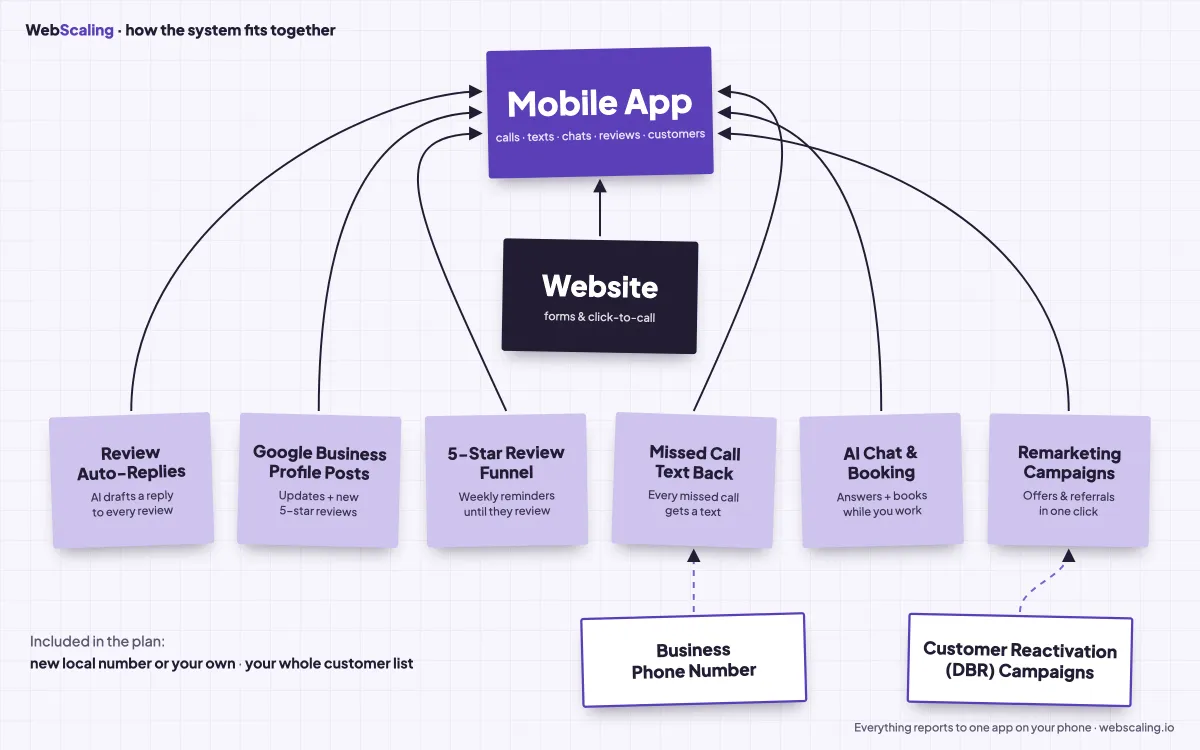
When you can't answer, the caller instantly gets a text from your business number: "Sorry we missed you, how can we help?" Most people reply by text instead of ringing the next business. It's the quickest win for most trades. See how missed call text back works, or read our guide on setting up missed call text back.
2. Send an instant, useful form auto-reply
"Thanks for your message" isn't enough. A good auto-reply confirms what they asked for, says when you'll be in touch, asks one useful question (such as a photo of the problem) and includes a booking link if you have one.
3. Add website chat that can answer and book
Many people look for help in the evening. A chat assistant can answer common questions, collect the job details and offer appointment times while the visitor is still on your site. See AI chat and booking.
4. Put every channel in one inbox
Leads get lost when calls, forms and Facebook messages live in different apps. One inbox shows every conversation and what still needs a reply. See our CRM and unified inbox.
5. Turn on mobile notifications and assign an owner
Push notifications on your phone mean you see a new enquiry between jobs, not at the end of the day. If you have a team, decide who covers new leads each day, so nobody assumes someone else replied.
6. Save reply templates
Write your most common answers once: how you price, areas covered, availability, what happens next. Tweak them per customer and reply properly in under a minute.
7. Set up a follow-up sequence
Many leads don't answer the first time because they're busy, not uninterested. An automatic sequence makes sure nobody is forgotten, and stops the moment they reply.
Lead follow-up: an example 7-day cadence
Here's a simple plan for a new enquiry from someone who hasn't replied yet. Adjust it to your business, and stop the moment the customer responds or asks you to stop.
Day 0, instantly: automatic text or email. "Hi Sarah, thanks for contacting Your Business about your boiler. James will call you shortly. Any photos of the problem help, just reply here."
Day 0, within 5 minutes: call. If there's no answer, leave a short voicemail and send a text saying you tried.
Day 0, a few hours later: one more call attempt.
Day 1: text. "Hi Sarah, just checking you saw my message. Would Thursday morning work for a visit?"
Day 3: email with something useful: what the job usually involves, a rough idea of cost if you give one, and a link to your reviews.
Day 5: call once more.
Day 7: final, friendly text. "Hi Sarah, I'll stop chasing so I don't clutter your phone. If you still need help, just reply and we'll fit you in."
What not to do
Don't spam. Five calls in an hour or a daily text for a month will annoy people and get you blocked. Fast first, then patient.
Don't sound robotic. Use their name and mention the job they asked about.
Don't stop at the auto-reply. It buys you time, it doesn't replace a real reply.
Don't pretend an assistant is a person. If chat or texts are automated, keep them honest and hand over to a human when needed.
Don't add leads to marketing without consent. Replying to someone's own enquiry is different from sending them offers. In the US, the FCC says autodialed texts to mobiles need prior consent, commercial texts need written consent, and people can opt out in any reasonable way. In the UK, ICO guidance says marketing texts and emails need specific consent (or the "soft opt-in" for existing customers) and an easy opt-out in every message. Rules in other countries differ, so check with your local regulator if you're unsure, and always honour "stop" straight away.
How WebScaling can help
WebScaling is a web agency for small businesses in Morocco and around the world. We start with your website and the 5-service pack: a website that turns visitors into calls and messages, your Google Business Profile and reviews, SEO, visibility in AI answers (GEO) and a client dashboard. When your business is ready, we add premium services such as Google & Meta Ads, AI agents, automations and dashboards.
Book a free call: you get a clear plan and a fixed quote, with no hidden fees.
FAQ
What is speed to lead?
It's the time between a potential customer contacting you (a call, form, chat or message) and your business replying. The shorter it is, the more likely you are to reach them while they still need help.
How fast should you respond to a lead?
Send an automatic reply instantly, then aim for a real reply within 5 minutes during opening hours and within an hour at most. HBR research found that trying within an hour made firms nearly seven times as likely to qualify a lead as waiting an hour longer.
What is the 5-minute rule?
It comes from the InsideSales.com and MIT Lead Response Management study, which found the odds of reaching a web lead were 100 times greater, and of qualifying them 21 times greater, when called within 5 minutes rather than 30.
Does an automatic reply count?
It counts as a first reply and stops the customer feeling ignored, but it isn't the whole job. Follow it with a real reply from a person as quickly as you can.
How do you calculate lead response time?
For each enquiry, subtract the time it arrived from the time a person replied. Average these, and also check the median and how many got no reply at all.
How many times should you follow up with a lead?
There's no fixed rule. A handful of calls, texts and emails over about a week is reasonable, as in the cadence above. Stop as soon as they reply or ask you to stop.

WebScaling is a web agency for small businesses in Morocco and around the world: websites, Google Business Profile and reviews, SEO and AI visibility, then ads, AI agents, automations and custom software.